

[On hold] Deprecating Home Assistant Supervised on generic Linux
[更新 May 26]
New 博客 post published with next steps.
[更新 May 10]
We’ve been overwhelmed with the many reactions. We realize our communication has been poor on this subject, for which I want to apologize. We do not collect data and so can’t always judge the impact of our decisions.
We’re going to put the deprecation plan on hold for now. Anyone running this 安装 method today can continue running this. We will offer more clear information in the future.
We’re going to investigate how we can maintain the 受监管模式 安装 on generic Linux.
Furthermore, we are going to make sure that supported 安装 guides are properly documented.
Paulus
TL;DR: Home Assistant 受监管模式 (also known as Home Assistant on Generic Linux) 安装 method is no longer supported.
There are currently three different ways of installing Home Assistant:
- Home Assistant: our operating system running either directly on a supported 设备 like the ODROID N2, 树莓派 4, Intel NUC or a virtual machine.
- Home Assistant 受监管模式: an 安装 of 核心 + supervisor that are hosted on a generic Linux 安装.
- Home Assistant 核心: our Python 核心 application running in a Python virtual environment or a Docker 容器.
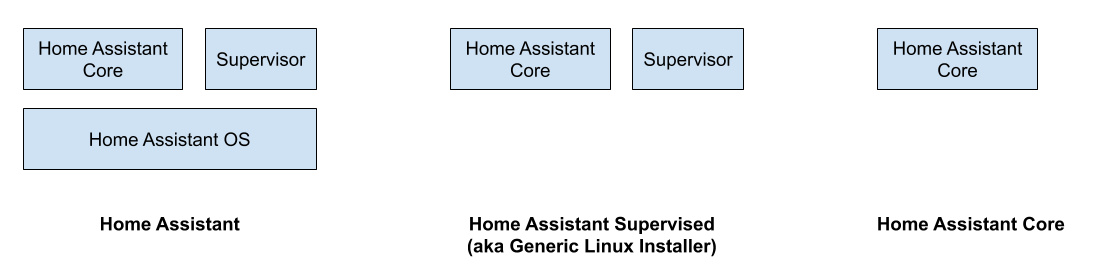
The benefit of running the Supervisor is that you are able to keep Home Assistant up to date from within Home Assistant, and easily 安装 插件 that are pre-configured to be able to integrate with Home Assistant.
The Supervisor is an extremely complicated program that interacts with a wide range of applications and components in the host operating system. Examples are Docker 容器, DNS, sound and USB hardware sticks that 用户 want to use with Home Assistant. The Supervisor is controlled from Home Assistant which allows us to create a full home 自动化 hub experience.
The Home Assistant operating system is made with the bare minimum that the Supervisor needs to run and makes sure it does not get in the way of the Supervisor: the system is fully managed by the Supervisor.
Some 用户 still wanted to be able to control the host operating system, and so a generic installer was introduced that could 安装 Home Assistant 核心 and Supervisor on a generic Linux system, like Debian or Ubuntu.
However, when people run it on top of their own system, things can go wrong. And in fact, it’s quite complex to maintain it on generic Linux. Installing is fine, everyone can follow a 教程, but after that when things break, people come to us, not the author of the 教程. And this workload keeps growing, to a problematic extent.
Home Assistant OS and Supervisor are being maintained by Pascal. He started them 3,5 years ago and has been maintaining this first in his spare time, later as a full-time employee of Nabu Casa.
Building the operating system and the supervisor is a complex task that requires specific expertise. Sadly after 3,5 years, there are still no other contributors to help. This has resulted in his responsibilities outgrowing what one can expect from a full-time employee.
Nabu Casa was founded to make the development of Home Assistant sustainable. To be able to maintain a healthy work/life balance and to avoid developer burn-out that is, unfortunately, common in the 开源 world.
In an effort to reduce Pascal’s constraints we’re per direct no longer supporting the generic Linux 安装 method. It will no longer be mentioned in the 文档. We have archived the repository. If you are willing to maintain it, feel free to fork it. Issues that result from using this will be ignored or closed when reported to us.
开源 & Community
Just as with our recent decision to limit the usage of YAML in some cases, Home Assistant will keep choosing health over features. 开源 is not about us having to support every feature anyone on the internet can think of. 开源 means that anyone can do that themselves and choose to share this or not.
There are still tons of ways of installing Home Assistant, there are still tons of features and customizations possible.
Frequently Asked Questions
How do I run Home Assistant while still keeping control over the operating system?
We offer a virtual machine 图像 of Home Assistant. These 图像 can be used on e.g., VMWare, VirtualBox and Proxmox, and also on NAS systems that support running a VM as most modern NAS systems do. Using these provided 图像 will give you the full supported Home Assistant experience.
You can find virtual machine images here.
I run on a platform that doesn’t support VMs and I still want to keep control over the operating system.
To do this we recommend running Home Assistant 核心 in Docker. You will lose out on the easy updates, system management and pre-configured apps (插件) from the UI. However, you are still able to run the full beating heart of the Home Assistant home 自动化 platform.
All applications that are available as Home Assistant 插件 are also available as third-party Docker 容器. You will be responsible to 配置 them to work with Home Assistant 核心 yourself.
I know what I am doing. Can I still use the generic Linux installer?
Yep, the archived repository is still there. You can also fork it and change things. But there is no official resource to visit when things break.
I am currently running Home Assistant 受监管模式. Now what?
Everything will continue to work as-is. Bugs won’t be fixed and you should consider migrating to one of the other methods. If you are migrating to a virtual machine, you can make a snapshot in the Supervisor 面板 and 恢复 that in your new 安装.
[Edit May 9, 16:19] Removed paragraph from 开源 & Community as it was insinuating.