Set up Hass.io on top of a virtual machine
The 图像 for the 树莓派 family and the Intel NUC are an easy way to get started with Hass.io. For a test or if you have a system which is already hosting virtual machines then the Hass.io installer is an option to use Hass.io in a virtualized environment. In this guide the host is a Fedora 27 system with libvirt support and the guest will be running Debian 9. Hass.io will be 已安装 on the guest.
Assuming that you already have 设置 libvirtd. You might need to 安装 virt-builder and virt-viewer additionally.
sudo dnf -y install libguestfs-tools-c virt-install virt-viewer
We will create a virtual machine with Debian 9 and a 10 GB disk 图像 in the QCOW format. Use $ virt-builder --list to get an 概述 about what's operating systems are available if you prefer to use a different system.
$ sudo virt-builder debian-9 \
    --output /var/lib/libvirt/images/hassio.img \
    --format qcow2 \
    --size 10G \
    --root-password password:test123 \
    --hostname hassio \
    --firstboot-command "dpkg-reconfigure openssh-server"
[...]
[ 147.6] Finishing off
                   Output file: /var/lib/libvirt/images/hassio.img
                   Output size: 10.0G
                 Output format: qcow2
            Total usable space: 9.3G
                    Free space: 8.1G (87%)
Now, we are making our new virtual machine available for libvirtd. If you get an 错误 that the OS is unknown, use $ osinfo-query os to get the name to use with --os-variant. To access the virtual machine is connected to the bridge bridge0.
$ sudo virt-install --name hassio --import --ram 1024 \
     --os-variant debian9 -w bridge=bridge0 \
     --autostart --disk /var/lib/libvirt/images/hassio.img
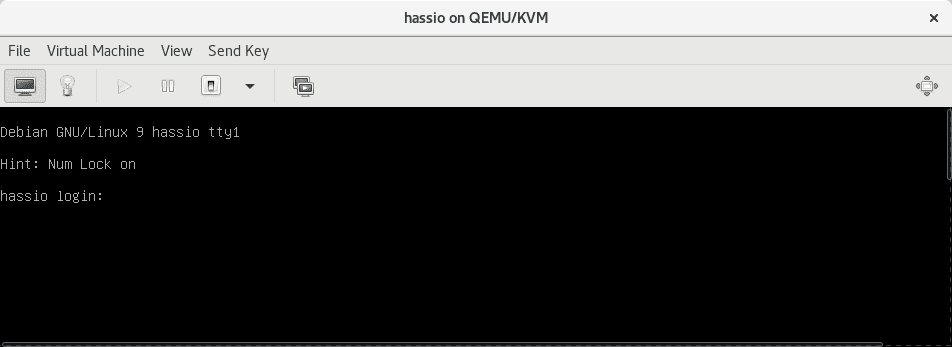 Hass.io virtual machine in Virtual Machine Manager
Depending on your preferences you can use the Virtual Machine Manager (virt-manager) or virsh to manage the 创建 virtual machine. 日志 in and create an 用户 with # useradd ha and set a 密码 with # passwd ha. We will need that 用户 to make a SSH connection to the virtual machine.
日志 in as ha with the given 密码. If your are using the default network of libvirtd then the DHCP range is defined in /var/lib/libvirt/dnsmasq/default.conf. In this guide the virtual machine is present at 192.168.0.109.
$ ssh ha@192.168.0.109
ha@192.168.0.109's password:
Linux hassio 4.9.0-3-amd64 #1 SMP Debian 4.9.30-2+deb9u3 (2017-08-06) x86_64
[...]
$
安装 the requirements after you 开关 the 用户 to root.
$ su
Password:
root@hassio:/home/ha#
root@hassio:/home/ha# apt-get update
root@hassio:/home/ha# apt-get install bash socat jq curl avahi-daemon \
    apt-transport-https ca-certificates
We want the latest Docker 发布. This requires additional steps to set it up as unlike other distributions Debian is lacking behind with current packages.
root@hassio:/home/ha# wget https://download.docker.com/linux/debian/gpg
root@hassio:/home/ha# apt-key add gpg
OK
root@hassio:/home/ha# echo "deb [arch=amd64] https://download.docker.com/linux/debian $(lsb_release -cs) stable" | tee -a /etc/apt/sources.list.d/docker.list
root@hassio:/home/ha# apt-get update
Now, it's possible to 安装 a current 发布 of Docker.
root@hassio:/home/ha# apt-get -y install docker-ce
Start docker and enable it.
root@hassio:/home/ha# systemctl start docker && systemctl enable docker
An 安装 脚本 will take care about the 设置 of all moving parts.
root@hassio:/home/ha# curl -sL https://raw.githubusercontent.com/home-assistant/hassio-build/master/install/hassio_install | bash -
[INFO] Install supervisor docker
[INFO] Install generic HostControl
[INFO] Install startup scripts
[INFO] Init systemd
Created symlink /etc/systemd/system/multi-user.target.wants/hassio-supervisor.service → /etc/systemd/system/hassio-supervisor.service.
[INFO] Start services
If it's done, then there will be two new 容器.
root@hassio:/home/ha# docker ps
CONTAINER ID        IMAGE                                    COMMAND                  CREATED             STATUS              PORTS               NAMES
ada5bbfc74f0        homeassistant/qemux86-64-homeassistant   "/usr/bin/entry.sh..."   4 minutes ago       Up 4 minutes                            homeassistant
5954ac452ffc        homeassistant/amd64-hassio-supervisor    "/usr/bin/entry.sh..."   7 minutes ago       Up 7 minutes                            hassio_supervisor
After a connection to the 容器 which is containing Home Assistant is made, you will see the 日志 output.
root@hassio:/home/ha# docker attach --sig-proxy=false ada5bbfc74f0
2017-11-28 19:24:30 INFO (MainThread) [homeassistant.core] Bus:Handling <Event state_changed[L]: entity_id=sun.sun, old_state=<state sun.sun=below_horizon; next_dawn=2017-11-29T06:17:58+00:00,...
For further details about the 容器, inspect can help.
root@hassio:/home/ha# docker inspect bb32b525d1ad
[...]
            "OnBuild": null,
            "Labels": {
                "io.hass.arch": "amd64",
                "io.hass.machine": "qemux86-64",
                "io.hass.type": "homeassistant",
                "io.hass.version": "0.58.1"
            }
[...]
Hass.io is now ready. The 前端 is available at http://192.168.0.109:8123. Yes, the IP address is the one of the guest.
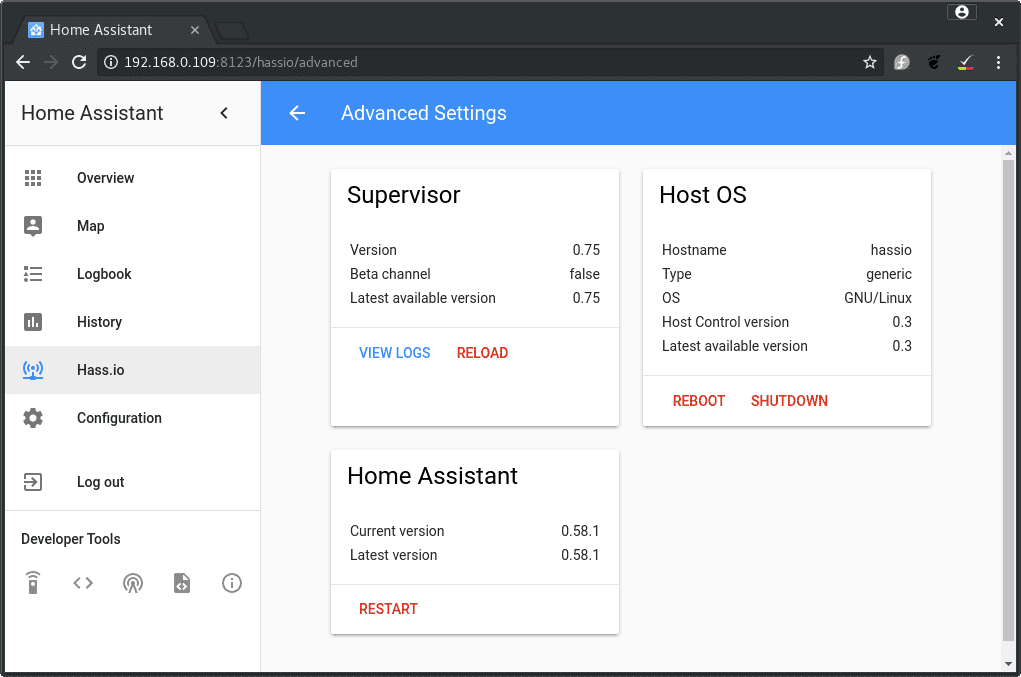 Hass.io 概述
Keep in mind that there are limitations with this approach. Not all add-ons will work and some don't make sense to use as the hardware is not present. E.g., use the SSH community add-on instead of the default SSH add-on.